
Overview#
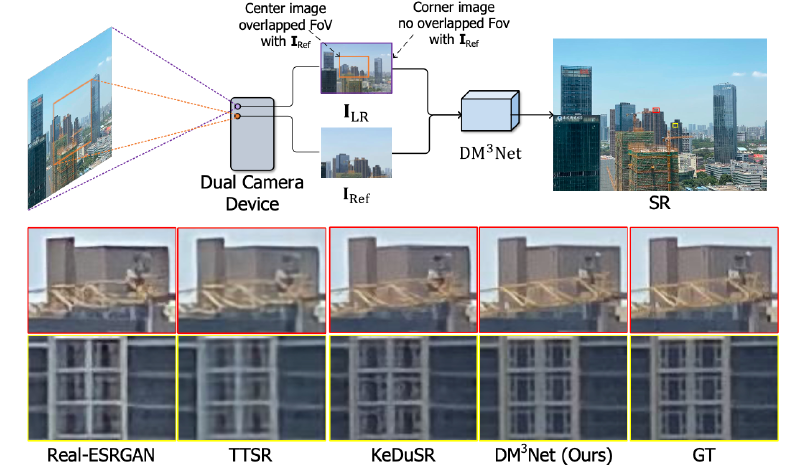
However, these images have field of view (FoV) mismatches and resolution/color domain differences, making high-definition reconstruction difficult through simple image fusion.
Background and Challenges#
In smartphone dual cameras:
- Wide-angle camera: Covers a wide field of view but has low resolution
- Telephoto camera: Has a narrow field of view but contains high-resolution details
The goal of Dual-Camera Super-Resolution is to use the telephoto image as a “reference image” to enhance the wide-angle image to high definition. Conventional methods (e.g., DCSR, KeDuSR) transfer high-frequency information through patch-level feature matching, but had problems with reduced detail reproduction due to scale constraints.
Proposed Method: Key Components of DM³Net#

1. Multi-Scale Matching#
Calculates feature patch similarity at multiple receptive field scales (1/4, 1/2, 1) and selects the optimal reference patch. This significantly improves structural consistency and detail reproduction compared to conventional single-scale matching.
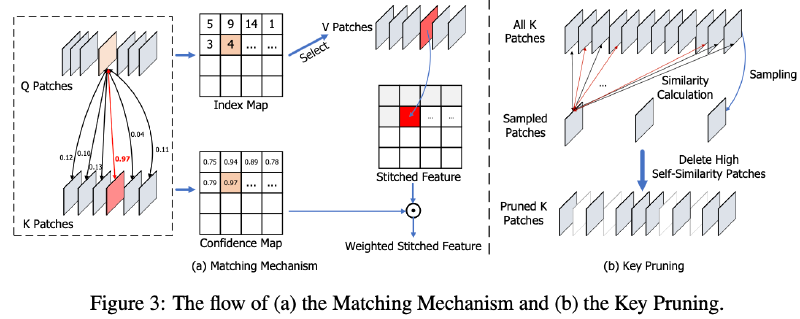
2. Domain Modulation#
Wide-angle images (LR) and telephoto images (Ref) have domain differences due to different capture pipelines. Therefore, DM³Net learns global domain embeddings (z, zgt) from each pair (LR-GT, LRc-Ref). By introducing a “domain-aware loss (L_domain)” that aligns the distributions of both and adaptively incorporating it into the reconstruction process, smooth mapping to the high-resolution domain is achieved.
3. Integrated Reconstruction#
Finally, high-frequency features reconstructed through matching and domain-modulated embedding information are integrated to generate visually natural and high-fidelity HR images.
Experimental Results#
Ablation Studies and Discussion#
- Multi-scale: PSNR improves as scales increase (27.75 dB).
- Domain modulation: Best performance when using both z and zgt.
- Key Pruning: Optimal balance at threshold 0.7 and sampling interval 16.
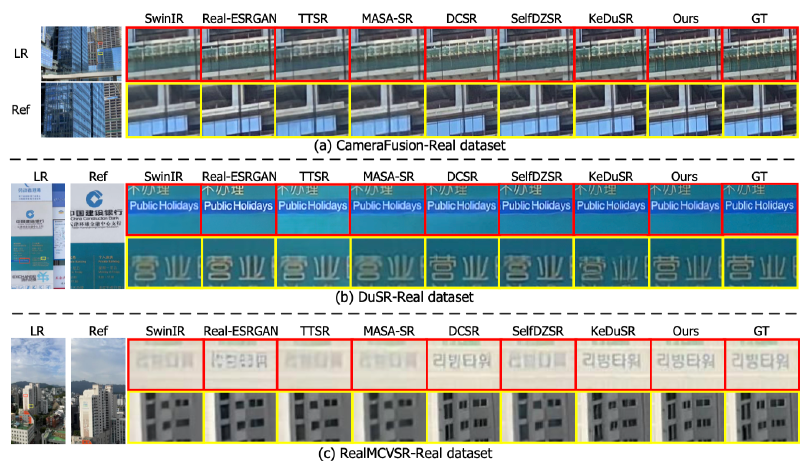
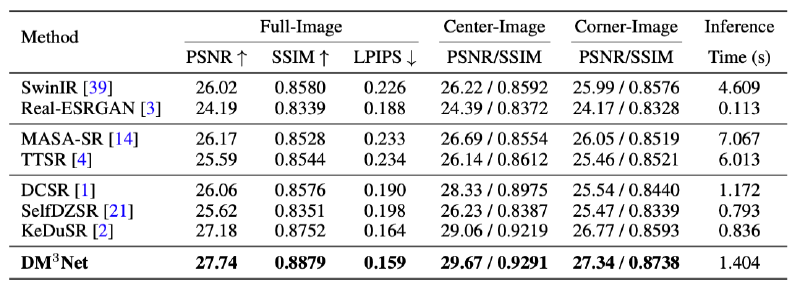
From these results, it is analyzed that DM³Net’s performance improvement comes from the combination of improved local matching accuracy and introduction of global domain alignment.
Applications and Future Prospects#
DM³Net is directly applicable to multi-lens capture environments such as smartphones, drones, and vehicle-mounted cameras. In particular, it shows high potential in Computational Photography technology that integrates different angles of view, resolutions, and ISP processing across hardware.
In the future, model lightweighting and real-time processing are targeted, with application to diffusion-based restoration and video extension expected.